

How the idea of the “bankable” customer was formed
Financial institutions need information. Before modern credit bureaus and automated scoring systems, that information could come from personal relationships, reputation, occupation, assets, guarantors and community standing. Research on early eighteenth-century London, for example, shows that personal networks and trusted relationships remained important to banking and credit decisions even as commercial banking expanded.
Over time, formal finance developed more standardized mechanisms for turning these judgments into institutional processes. Collateral could substitute for personal knowledge of a borrower. Income documentation could substitute for familiarity with a customer’s business. Credit histories could substitute for a lender’s personal knowledge of someone’s repayment behavior. Risk models could turn large volumes of information into decisions that could be applied across thousands or millions of customers.
These innovations made financial systems more scalable. They also created new boundaries around who was easily legible to those systems.
A borrower without conventional collateral could be difficult to finance. A business without formal accounts could be difficult to assess. A worker without a stable salary could appear riskier than someone with regular payroll income, even when both had the capacity to repay. And someone living far from a branch could face a different barrier altogether: the financial institution might exist, but access to it did not.
These barriers were reinforced by law and social institutions. Research on nineteenth-century Yucatán found that marital property regimes and the unequal legal position of husbands and wives shaped women’s participation in local credit markets.
This reveals that the rules used to determine financial risk can reflect the economic, legal and social structures of the societies in which those rules are created. And when those structures are unequal, the consequences can be unequal too.
When the financial system cannot see the customer
A financial institution can only assess what it can observe.
For decades, formal financial systems have relied heavily on information such as documented income, collateral, identity, previous borrowing and repayment records. People who lack these forms of evidence can therefore face a paradox: they may have years of experience managing money, running a business or repaying informal loans, yet have little formal evidence with which to demonstrate that experience to a bank.
The problem becomes particularly acute for women and people operating small businesses in informal economies, who are more likely to lack the collateral, credit history and documentation that conventional lenders ask for.
This exclusion can then reproduce itself. Without access to formal financial services, a person may not build a formal credit history. Without a credit history, accessing formal credit can become harder. Without credit, a business may struggle to invest and grow. Without growth, there may be less documented income or business history to present to a lender.
Exclusion can therefore become cumulative. And this is why financial inclusion is not simply about giving people access to a bank account. It is about changing the conditions under which financial participation becomes possible, visible and useful.
That is the problem the financial inclusion movement emerged to address.
Financial Exclusion Created the Need for Financial Inclusion
Financial inclusion emerged from a recognition that the existence of a financial system does not mean that the system is equally accessible to everyone.
The idea gained prominence through the micro-credit movement of the 1970s and became a much broader development agenda in the following decades. What began with an emphasis on extending small amounts of credit to low-income borrowers evolved into a recognition that households and businesses need a wider range of financial services to manage their economic lives: safe places to save, reliable ways to make and receive payments, credit to invest, insurance to manage risk and mechanisms that allow them to build financial resilience. By the early 2000s, financial inclusion had become an established part of the global development agenda.
That evolution was important because access to credit alone could not solve the problem. A person who cannot save securely remains vulnerable even if they can borrow. A household with an account but no affordable way to insure against a health emergency can remain financially fragile. And a customer who technically has access to a financial product but cannot understand its terms, afford its fees or seek redress when something goes wrong is not necessarily better off because the product exists.
The World Bank defines financial inclusion around access to and use of affordable financial products and services, including payments, savings, credit and insurance, delivered responsibly and sustainably. CGAP similarly emphasizes not only access but people’s ability to use financial services that meet their needs.
The distinction between access and use is particularly important. A financial institution can operate in a community without that community being financially included. A bank branch may exist, but its minimum balance may be too high for a low-income customer. A digital service may eliminate the need to travel to a branch, but require a smartphone, reliable connectivity or digital skills that a customer does not have.
This is why the financial inclusion conversation has increasingly moved from the question of whether people are inside the system to the question of whether the system is useful to them. CGAP’s current work on “Financial Inclusion 2.0” captures this shift. Account ownership alone cannot explain whether people are managing financial shocks, controlling debt, meeting everyday obligations or building toward longer-term goals, so financial inclusion is increasingly being considered alongside financial health: whether financial services actually improve people’s ability to manage their financial lives.
Inclusion has to account for the rules around finance, not only the products
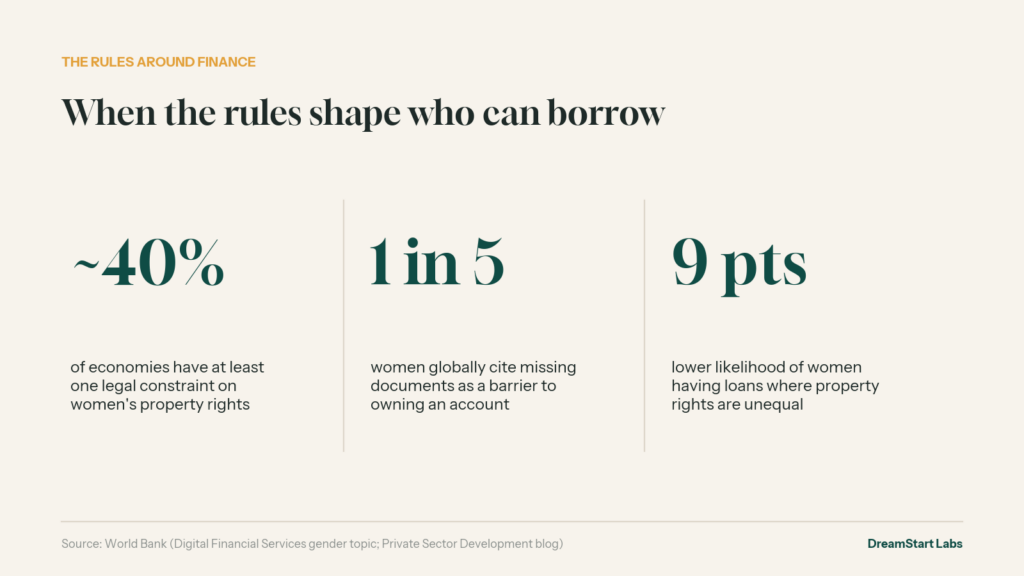
Gender provides one of the clearest examples. The World Bank estimates that around 400 million women are entrepreneurs globally, yet women-owned businesses continue to face substantial financing constraints, with collateral requirements, limited credit histories and gender-related barriers among the factors holding them back.
The legal environment can reinforce this. Nearly 40% of economies have at least one legal constraint affecting women’s rights to property, and World Bank research has found that women are, on average, nine percentage points less likely to have loans in economies where they do not have the same property rights as men. Property is not only an asset; within conventional lending systems, it can also be a gateway to credit.
Documentation creates another barrier. Globally, one in five women report that lacking the necessary documents is a barrier to owning a financial account. The World Bank also identifies know-your-customer requirements and customer due-diligence processes that are not proportionate to risk as potential obstacles for financially excluded populations.
If the underlying rules continue to assume that the ideal financial customer has formal income, conventional collateral, complete documentation, a stable address and an established credit history, expanding the number of financial products available will not necessarily remove exclusion. The system has to change alongside access.
Access is the starting point: financial services need to be available at a cost people can reasonably afford.
But access without capability is limited. People need the financial literacy to understand products, compare costs, assess risk and make informed decisions, which is why financial capability is treated as an essential component of responsible financial inclusion rather than a secondary intervention.
Then there is equity. Financial systems have to account for the gender, income, geographic, cultural and social conditions that determine who can actually use them. A product can be formally available to everyone while remaining practically inaccessible to people whose circumstances do not fit its assumptions.
There is also the question of appropriateness. Inclusion does not mean giving every customer the same product. A smallholder farmer with seasonal income does not have the same cash-flow pattern as a salaried employee, and a system that recognizes only one of these economic realities will inevitably serve some people better than others.
Fair assessment is another part of inclusion. Credit systems need enough information to manage risk, but they also need to avoid turning the absence of a conventional financial history into permanent evidence of risk.
Finally, there is protection and agency. As financial services reach more people, particularly through digital channels, consumers need protection against fraud, misleading products, inappropriate lending, data misuse and opaque fees. But protection only becomes meaningful when the consumer can understand the product, recognize when something is wrong and act on that knowledge.
That is why financial inclusion ultimately concerns more than access to financial infrastructure. It concerns people’s ability to use financial services safely and effectively, make decisions about their own financial lives and convert those services into greater economic opportunity and resilience.
How Far Have We Come? From Access to Meaningful Use
The financial inclusion agenda has changed substantially over the past two decades, and some of the most consequential changes have come from the infrastructure through which people access and use financial services.
According to the World Bank’s Global Findex 2025, based on nationally representative surveys of approximately 148,000 adults across 141 economies, 79% of adults globally had a financial account in 2024, up from 74% in 2021. In low- and middle-income economies, the share of women with an account increased from 37% in 2011 to 73% in 2024. At the same time, 1.3 billion adults globally remained without an account, with gaps persisting among women, poorer adults and people with limited digital connectivity.
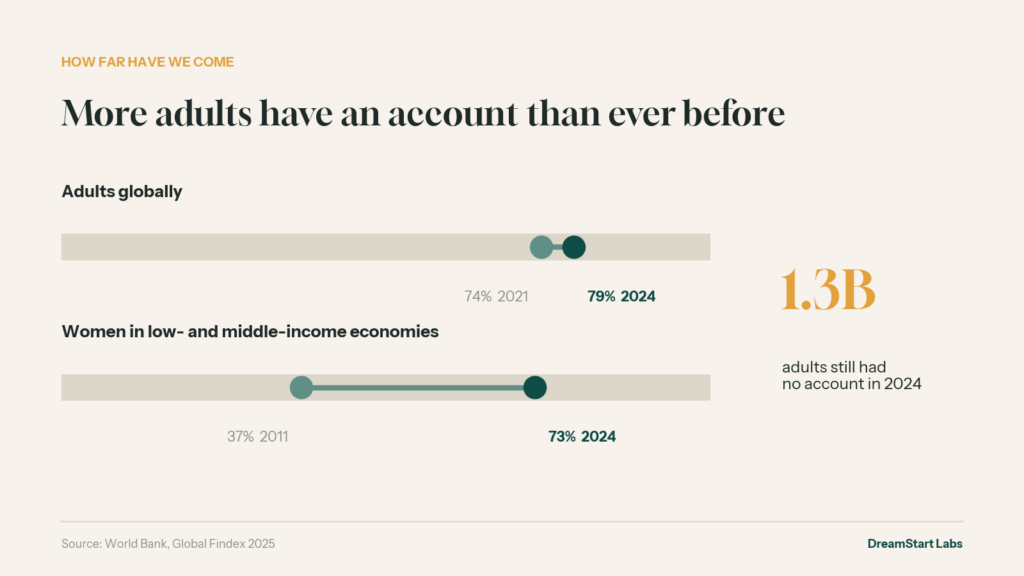
The latest Findex also expands measurement beyond account ownership to how people save, borrow, make payments and manage financial risks, and it now measures mobile-phone ownership, internet use and digital safety, reflecting how closely financial inclusion is now connected to digital infrastructure.
The numbers tell two stories at once. The first is a story of extraordinary expansion. The second is a reminder that access is not the same as inclusion.
Mobile money changed the meaning of access
Few innovations illustrate this better than mobile money. Traditional banking requires physical infrastructure. A customer may need to travel to a branch, complete documentation, maintain an account and interact with a financial institution during operating hours. Mobile money changed the economics and geography of access by moving basic financial transactions onto telecommunications infrastructure and distributing the physical interface through agent networks.
The GSMA’s State of the Industry Report on Mobile Money 2026 records 2.3 billion registered mobile money accounts globally at the end of 2025, an increase of 268 million in a single year. More than $2 trillion flowed through mobile money services during 2025, a 23% increase in transaction value from 2024.
The physical infrastructure behind those numbers matters just as much as the accounts themselves. There were approximately 30 million registered mobile money agents globally in 2025, including 11 million active monthly agents. These agents cashed in around $430 billion during the year, demonstrating how digital financial services still depend on physical points of interaction, particularly where cash remains central to everyday economic life.
In many markets, the most effective digital financial infrastructure has been built by connecting the digital and physical worlds. The technology changed the delivery mechanism without requiring people to completely change the way their economic lives worked.
Yet mobile money also reveals the next challenge. Only 593 million of those accounts, about 25.7%, were active over a 30-day period in 2025, and the industry itself now describes its challenge as moving beyond access at scale towards meaningful, everyday use. An account that exists but is rarely used is different from a financial service that is integrated into someone’s economic life.
Agent banking brought financial infrastructure closer to the customer
The same principle applies to agent banking. For communities far from bank branches, the economics of traditional branch infrastructure sometimes made serving those customers difficult. Agent banking changed that equation by allowing existing businesses, merchants and other local operators to provide selected financial services on behalf of regulated institutions.
If accessing an account requires a two-hour journey, transport costs, time away from work and uncertainty about whether a transaction can be completed, the nominal existence of the account tells us very little about whether the service is accessible. Agent networks reduce some of those costs by placing financial infrastructure closer to where people already live and trade.
This is particularly relevant in economies where informal businesses and cash-based commerce remain significant, and it reflects a principle increasingly visible across digital finance: the closer financial services are to people’s existing behavior, the lower the cost of participation can become.
Digital payments are changing what can be observed
Digital payments have introduced another important shift. When a transaction takes place digitally, it produces a record, and that record can make economic activity easier to document than it was when transactions were predominantly cash-based.
The World Bank’s Global Findex 2025 reports that digital merchant payments reached 42% of adults globally in 2024, up from 35% in 2021. The World Bank also notes that digital payment records can provide small-scale merchants with evidence of cash flows that may support applications for working capital or other forms of credit.
This is where the connection between financial inclusion and financial visibility becomes particularly important. For a small business that has never produced the financial statements traditionally requested by a bank, a consistent record of digital sales can begin to demonstrate the existence and scale of its economic activity.
The implications extend beyond credit. Transaction records can help people track their own finances, reduce the risks associated with carrying cash and help businesses reconcile sales. And, when appropriate safeguards exist, they can create information that supports access to other financial products.
Digital identity can remove a different kind of barrier
Financial institutions need to know who their customers are. Customer identification and know-your-customer requirements are important tools for preventing fraud, money laundering and other forms of financial crime. But, as the documentation gap shows, those same requirements can become barriers when people lack the documents or records that financial institutions expect.
Digital identity systems, when designed appropriately, can help address part of this problem by making identity verification more portable and potentially reducing the cost and friction involved in proving who someone is.
The policy challenge is to find the balance between access and risk. This is why the World Bank’s work on gender and digital financial inclusion recommends risk-based and tiered know-your-customer approaches, alongside enabling agent banking regulations and investment in credit infrastructure.
Alternative data is challenging the idea of a conventional financial history
Traditional credit systems depend heavily on evidence of previous formal financial activity. That works well for customers who already participate in formal finance, but it leaves the circular problem at the center of financial exclusion untouched: a person cannot build a formal financial history while excluded from the services that create it.
Alternative credit assessment attempts to break that cycle by considering other forms of information. The World Bank identifies it as one potential tool for improving women’s access to credit, particularly where women face limited credit histories or lack conventional collateral. Alternative data can include information such as mobile-phone usage patterns, although significant questions remain about what data should be used, how it should be interpreted and what protections should govern its use.
But more data does not automatically mean better inclusion. An algorithm can reproduce the biases contained in the data on which it is trained. A new form of scoring can create a new form of exclusion if customers do not understand how decisions are made or cannot challenge inaccurate information.
Inclusive credit assessment therefore requires more than finding new data. It requires fairer ways of interpreting financial behavior, particularly for women and other customers whose economic activity has historically been poorly captured by conventional financial records.
Financial education has become part of the infrastructure
As financial services have become more accessible, the need for financial capability has become more visible. This is particularly important in digital finance, where the distance between the provider and customer can be reduced to a mobile phone interface. The same convenience that makes a service accessible can also make it easier for customers to accept terms they have not understood, disclose information without appreciating the consequences or fall victim to fraud.
Financial education therefore has to evolve alongside financial technology. It is no longer sufficient to teach people how to open an account. People need to understand fees, interest, repayment obligations, digital security, fraud, data privacy and the difference between different financial products, and they need the ability to evaluate whether a product is appropriate for their circumstances.
And financial education cannot be treated as a one-time intervention. As products change and people’s financial needs change, capability has to develop with them.
Consumer protection is becoming more important, not less
The expansion of digital finance has also changed the nature of the consumer protection challenge. Traditional financial consumer protection has focused on issues such as transparency, fair treatment, disclosure, complaints and redress. Digital financial services add new dimensions, including data privacy, cybersecurity, fraud, algorithmic decision-making and the speed at which harmful financial products can reach large numbers of people.
The latest Findex highlights digital safety as a new area of global measurement, and its data shows that while mobile-phone ownership is widespread, digital safety practices, including the use of passwords and other security measures, are uneven. The GSMA’s 2026 mobile money report likewise identifies consumer protection and fraud controls among the priorities for the industry’s next stage of development.
This is an important signal of how far the sector has moved. Twenty years ago, much of the conversation was about whether underserved populations could gain access to financial services. Today, the sector is dealing with a more complicated question: how do we make increasingly sophisticated financial systems work safely and meaningfully for people who were historically underserved by them?
The progress is real. But the next generation of financial inclusion has to be concerned with use, quality, relevance, safety and outcomes, and it has to ask whether innovation is creating new pathways into finance without creating new forms of exclusion.
That is where some of the most interesting work in financial inclusion is now taking place. Not in replacing the financial systems people already use, but in finding ways to connect them. Savings groups offer one of the clearest examples.
Why Savings Groups Became Part of the Financial Inclusion Conversation
In savings groups, members pool their savings, lend to one another and manage their collective finances according to rules they set themselves. Their relationship with financial inclusion emerges because the systems that people created for themselves do not always connect easily to the institutions that control larger pools of formal capital.
A savings group may have a strong record of regular contributions and loan repayment. Its members may have operated businesses for years. The group may have accumulated substantial savings and demonstrated the ability to manage credit collectively. Yet none of this necessarily appears in a conventional credit file.
This creates an important gap between financial behavior and financial recognition. The World Economic Forum recently highlighted this problem, noting that an estimated 500 million people participate in informal savings groups globally, while financial institutions often do not recognize participation in those groups when assessing creditworthiness. CARE reported that its savings groups generated almost $1.4 billion in member savings in the preceding year, illustrating the scale of financial activity taking place within these community systems.
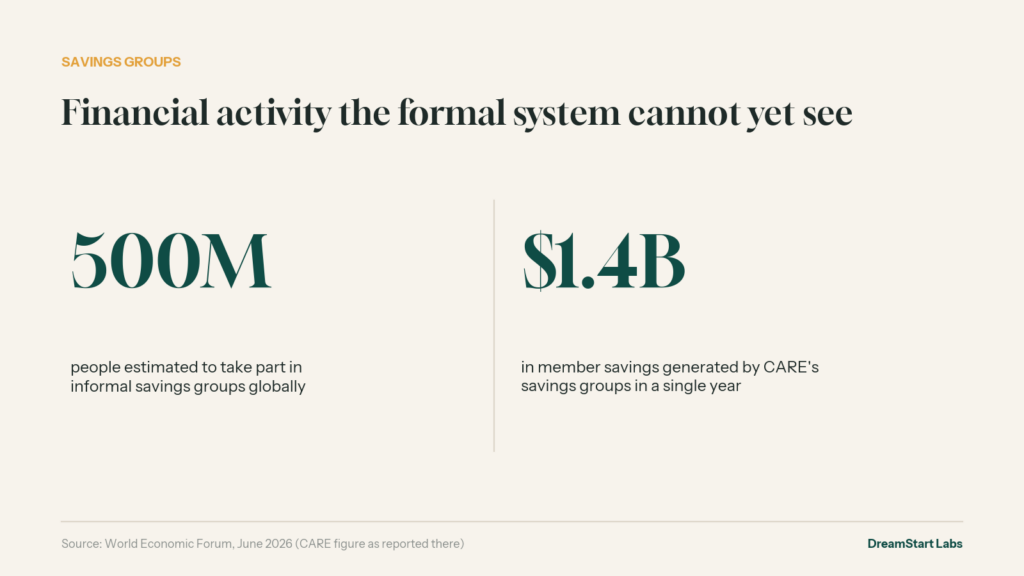
The issue is that the formal financial system has historically had limited mechanisms for interpreting what happens inside these groups. This is why savings groups have increasingly become part of financial inclusion strategies.
The Evidence Is Already Pointing in This Direction
There is growing evidence that savings groups can function as a bridge between people and financial services that have historically been difficult to reach them.
In Nigeria, for example, the World Bank’s Nigeria for Women Project has supported more than 458,000 women through 22,094 Women Affinity Groups. Between 2018 and 2024, these groups accumulated approximately $4.8 million in savings and managed more than $12 million in internal loans to support members’ livelihoods. The programme was designed in response to persistent barriers facing women in rural areas, where formal financial institutions can face high costs and logistical challenges in serving small-scale customers.
Savings groups can also reduce barriers to saving and participation, particularly for women. Their proximity to participants and reliance on community relationships can help address information asymmetries and trust problems that otherwise discourage formal institutions from serving poorer and more remote customers.
This is an important shift in the financial inclusion conversation. The goal should be to create pathways through which different parts of the financial ecosystem can connect.
Those pathways need care. A financial record should not become an automatic invitation to borrow, and more credit is not synonymous with greater inclusion. The evidence on inclusive credit is increasingly focused on precisely this question: under what product designs and conditions does credit actually benefit underserved borrowers without creating new financial harm? CGAP’s 2026 synthesis of 405 credit-focused studies emphasizes that the relevant question is not simply whether credit “works”, but for which borrowers, through which products and under what conditions.
The same principle applies to digitization. The purpose of digitizing a savings group should not simply be to produce data that another institution can consume. It should first make the group’s own financial life easier to manage.
Better records. Fewer calculation errors. Greater transparency. More efficient meetings. A clearer understanding of savings and loans. Stronger financial and digital capability.
Once that foundation exists, the information generated through those activities can potentially support connections to other parts of the financial system.
What Inclusive Digital Finance Looks Like in Practice
Before a savings group can benefit from digital tools, its members need to understand the financial practices that the technology is designed to support: how savings work, how loans are issued and repaid, how interest is calculated, how group funds are managed and why accurate records matter. That is why digitization cannot be treated as a technology deployment exercise.
At DreamStart Labs, savings groups are introduced to financial and digital capabilities as part of the process of becoming digitally enabled. Working with implementing organizations and community facilitators, groups receive training that strengthens members’ understanding of their financial practices while building the confidence to use digital tools.
From digital readiness to better financial management
Once groups are ready to use digital tools, the value of technology becomes more tangible.
Every meeting requires members to calculate contributions, update records, track outstanding loans, reconcile balances and make decisions about their collective finances. When those processes are done manually, the time required can become significant and errors can be difficult to identify. Our product DreamSave allows savings groups to record savings, loans, repayments and other group transactions digitally, automating calculations and reducing that administrative burden.
By September 2026, more than 50,000 savings groups across 37 countries were using DreamSave, representing nearly 1 million members. At that scale, the significance of digitization is not simply the number of groups using an application. It is the growing volume of financial activity being recorded, organized and preserved digitally across communities that have traditionally relied on paper records.
Independent research conducted by Opportunity International on its DreamSave groups shows what that change can mean at group level. In a seven-country pilot involving more than 16,000 members, 96% of members were satisfied with their record-keeping using DreamSave, while frequent disputes over financial records fell by 14 percentage points. Sixty-five percent also reported shorter meeting times.
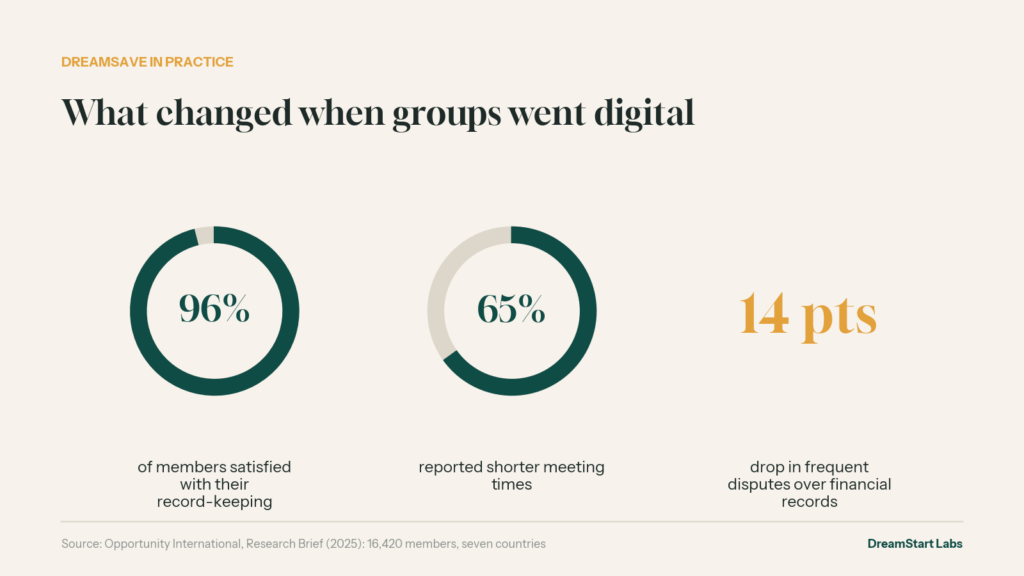
The significance goes beyond saving a few minutes during a meeting. When financial administration becomes easier, members can spend more of their meeting time discussing the financial decisions that actually matter. There is less room for simple arithmetic errors to become financial disputes, and members have a clearer view of the group’s financial position.
Some of the effects of digitization are less obvious. Every interaction with a digital financial tool can become an opportunity to build digital capability: understanding how to navigate an application, interpret financial information, verify a transaction and recognize the importance of maintaining accurate records. For people who have historically had limited exposure to digital financial services, these capabilities can become as valuable as the savings group itself.
The most significant possibility, however, may be what happens to the financial information over time. A savings group can generate years of financial behavior. When those activities are recorded digitally and consistently, they create a structured history of financial activity, and that history creates the possibility of a wider conversation about financial services, whether formal savings, payments, insurance or credit.
When Financial Inclusion Becomes Agency
A financial system can expand a woman’s ability to participate in economic activity without necessarily changing the social assumptions surrounding that activity. Financial inclusion therefore has another dimension: whether greater access to financial resources translates into greater economic agency.
A DreamSave savings group in Guatemala offers a revealing example.

In La Balaclera, in Santo Bartolo Aguascalientes, a community where World Vision has worked with savings groups, the groups initially faced a familiar form of resistance. They were groups of women, and that fact shaped how seriously they were taken within the community.
One member used the opportunities created through the group to start a small fruit and vegetable business. The business grew. She purchased a car to support it and later upgraded to a truck as demand increased.
The asset became evidence of something the community had initially failed to recognize: the women were not simply participating in a social activity. They were building economic institutions and using them to finance productive activity. And the change was not limited to one member. As the business expanded and its economic contribution became more visible, perceptions within the community began to change.
For the woman in this story, the progression was from collective saving to access to capital, from capital to enterprise, and from enterprise to growth. The savings group did not create her entrepreneurial ability. And DreamSave did not create her ambition. What changed was her ability to mobilize financial resources around those capabilities.
This is where the idea of financial inclusion becomes more consequential than account ownership. The objective is to expand the set of economic choices available to a person. It is also why gender cannot be treated as a secondary consideration within financial inclusion: when women encounter financial systems under different conditions, a technically neutral design is not enough.
The same principle applies to savings groups. The group itself can be an instrument of financial inclusion, but it can also become an instrument of agency because it gives members a structure through which they collectively exercise financial decision-making.
The Next Chapter of Financial Inclusion
The history of financial inclusion can be read as a gradual expansion of who financial systems are able to see. The Center for Financial Inclusion has described this as a broader shift from incremental gains in access towards outcomes such as financial health, resilience and economic participation.
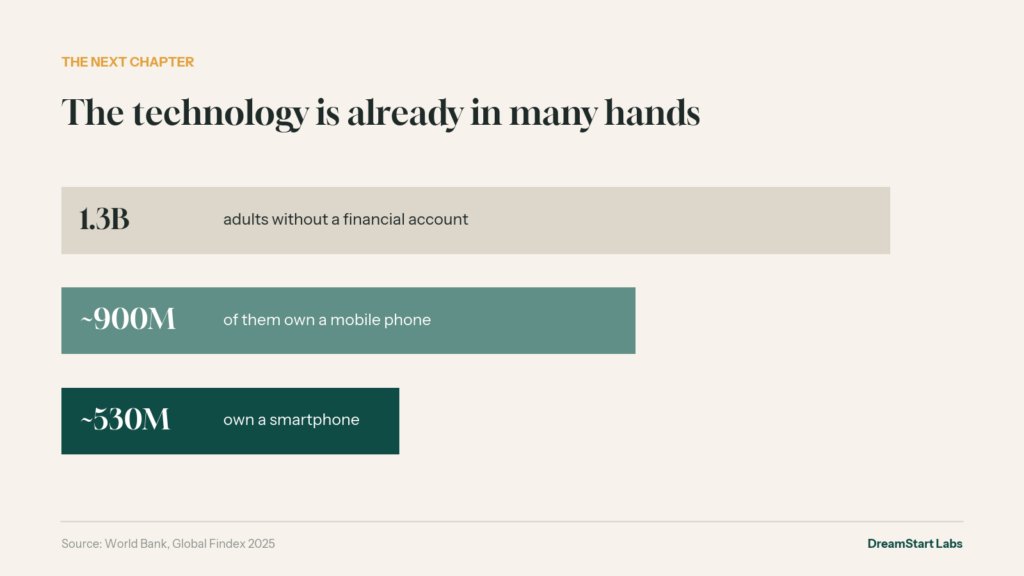
Of the 1.3 billion adults still without a financial account, nearly 900 million have a mobile phone, including around 530 million with smartphones. The infrastructure for digital inclusion therefore already exists for many people who remain financially excluded. The challenge is increasingly about what stands between having the technology and being able to use it meaningfully, safely and affordably.
That gap will not be closed by technology alone. It will require financial products that reflect the realities of people’s lives, credit assessment that does not penalize people for having been outside formal finance, financial education that keeps pace with increasingly complex digital products and consumer protection that can respond to fraud, scams and data risks as quickly as financial technology evolves. And it will require a broader understanding of where financial innovation can come from.
The Center for Financial Inclusion’s theme for Financial Inclusion Week 2026 is “Inclusive Innovation: Building Financial Systems That Work for Everyone.” CFI’s framing recognizes both sides of the current moment: emerging technologies can expand what is possible, but without intentional and responsible adoption, they can also leave vulnerable people behind. This year, the programme will examine technology-led innovation alongside women’s financial inclusion, financial education, financial health, resilience and consumer protection.
The emphasis on protection is particularly important. As more people enter digital financial systems, the consequences of getting inclusion wrong can become larger as well. CFI’s latest research on scams notes that exposure to fraud and scams has grown alongside digital financial inclusion. Its analysis cites Global Anti-Scam Alliance research finding that seven in ten adults globally encountered a scam in the preceding year, with reported prevalence reaching 68% in Africa. For newly included customers, CFI argues, a single harmful experience can damage trust in the financial system itself.
This is why inclusion and protection cannot be treated as separate agendas. Financial inclusion is ultimately about people having greater control over their economic lives.
That is the conversation Financial Inclusion Week creates space for. DreamStart Labs will be part of it, joining practitioners, policymakers, researchers and innovators examining how financial systems can become more inclusive, responsible and responsive to the realities of the people they serve. The week will take place virtually from October 5 to 8 and will bring together thousands of participants around the theme of inclusive innovation.
Our work with savings groups is one part of that larger conversation. Because the future of financial inclusion will not be built by asking people to leave the financial systems they already have behind. It will be built by finding better ways to connect what already works with what becomes possible next.