
Every week, across villages in Africa, Asia, and Latin America, millions of people gather to do something remarkably simple. They contribute small amounts of money into a shared pool, issue loans to one another, repay those loans with interest, and collectively decide how their financial future should be managed.
There are no marble bank branches. No credit officers. No collateral requirements. Often, there is not even an internet connection. Yet these groups have quietly become one of the world’s largest and most enduring financial systems.
Today, an estimated 500 million people participate in savings groups globally, with women accounting for roughly 80 percent of all members. These community-managed groups have become one of the most effective pathways to financial inclusion for women who continue to face structural barriers to formal financial services.
Despite their scale, savings groups are still frequently described as informal: a label that often implies they are temporary, unstructured, or somehow less capable than formal financial institutions.
The evidence suggests otherwise. Over the past two decades, rigorous studies across Sub-Saharan Africa, South Asia, and Latin America have consistently shown that well-designed savings groups help members save more, access affordable credit, invest in productive activities, and gain greater influence over household financial decisions. Rather than existing outside the financial system, savings groups have evolved into trusted community institutions that perform many of the same functions as formal finance, mobilizing capital, managing risk, extending credit, and enforcing repayment through accountability instead of collateral.
The question, then, is not whether savings groups work. They do.
The more important question is why millions of financially disciplined people who save regularly, repay loans, and manage collective funds remain largely invisible to the institutions designed to serve them. This is where digitization changes the conversation. Their viability has already been established; what technology adds is visibility. It transforms years of undocumented financial behaviour into verifiable financial histories, replacing paper ledgers with trusted records, informal reputations with digital footprints, and isolated community finance with a pathway into the broader financial ecosystem.
Financial inclusion, in other words, is not about replacing systems that already work. It is about helping the rest of the financial system recognize them.
Savings Groups Are Already Financially Viable
One of the biggest misconceptions about savings groups is that they exist because formal banking has failed to reach underserved communities. In reality, savings groups have endured because they solve problems that conventional financial institutions often cannot.
Unlike many formal financial products, savings groups are designed around trust, flexibility, and local accountability. Members determine their own rules, elect their own leaders, decide how much to save, agree on lending terms, and collectively enforce repayment. Every contribution, loan, repayment, and share-out happens transparently during regular meetings, creating a financial system built on participation rather than paperwork. This model has proven remarkably resilient.
Research on the CARE-pioneered Village Savings and Loan Association model finds that 89 percent of savings groups remain active five years after formation, with many groups expanding organically as experienced members establish new groups in neighbouring communities. Rather than depending indefinitely on external support, savings groups replicate through social trust and community ownership, demonstrating that the model is both financially and institutionally sustainable. Their success is perhaps most remarkable when viewed against the barriers their members face.
Globally, around 740 million women remain unbanked, while nearly 2.4 billion women of working age do not enjoy the same legal economic rights as men, limiting their ability to participate fully in formal financial systems. Women continue to encounter obstacles ranging from discriminatory lending practices and lower access to financial products to legal restrictions that affect property ownership, mobility, and economic participation. These barriers contribute to an estimated US$1.7 trillion financing gap for women-owned micro, small, and medium-sized enterprises.
For many women, these structural barriers are reinforced by social norms. Opening a bank account may require travelling long distances. Financial decisions may need approval from a husband or another family member. Limited financial and numeracy literacy can make formal banking intimidating, while traditional lending products often fail to reflect the realities of informal livelihoods.
Savings groups were never designed to eliminate these barriers overnight. They were designed to work despite them. By allowing women to save collectively, access affordable loans, and build financial confidence within trusted community networks, savings groups create opportunities that formal institutions have historically struggled to provide. The evidence increasingly shows that this participation changes more than financial behaviour.
According to the 2025 evidence synthesis by Innovations for Poverty Action, women participating in savings groups reliably show higher levels of savings and improved access to affordable credit. Studies also show that women become less dependent on expensive informal lenders and more likely to make decisions about business investments, food purchases, education, and healthcare within their households.
Crucially, these outcomes are not isolated to one geography. Across Ghana, Malawi, and Uganda, participation in Village Savings and Loan Associations increased total reported savings by 34 percent compared with non-participants, while studies found improved business activity, stronger access to credit, and increased influence over household decision-making. Similar findings emerge from studies in Peru, Mali, India, Côte d’Ivoire, and Cambodia, suggesting that the model performs consistently across diverse economic and cultural contexts.
The research also offers an important nuance. Savings groups are not a guarantee of higher household income in every context. The IPA review concludes that while evidence on income growth is mixed, the evidence for improved savings behaviour, better credit access, stronger financial resilience, and increased decision-making power holds up across the board.
The value of savings groups, then, is not simply that they help people earn more money. It is that they help people manage the money they already have more effectively. That is exactly what financial systems are supposed to do.
Digitization Doesn’t Make Savings Groups Work. It Makes Their Financial Behaviour Visible.
For decades, savings groups have operated on paper ledgers, notebooks, passbooks, and, in some cases, memory alone. These systems have worked remarkably well. They have enabled millions of people to save consistently, manage loans, build businesses, and support one another through emergencies. Their longevity is proof that the model itself is not broken.
But paper has its limits. A handwritten ledger cannot generate a credit profile. A notebook cannot demonstrate repayment behaviour to a bank. A passbook cannot produce the kind of financial history that lenders, insurers, and regulators rely on to make decisions. This is where digitization creates value. At its core, digitization is simply the process of converting years of trusted financial behaviour into structured financial data. Every contribution made during a weekly meeting. Every loan approved by the group. Every repayment completed on time. Every social fund contribution. Every annual share-out. Together, these transactions create something that paper records rarely can: a verifiable financial history.
Modern financial systems increasingly operate on data. Financial institutions make lending decisions based on evidence of repayment behaviour, transaction histories, and financial consistency. Yet millions of savings group members, despite demonstrating exactly these behaviours for years, remain invisible because their financial records exist only within their groups.
Digitization closes that gap. Research increasingly suggests that digital record-keeping does more than improve administrative efficiency. It strengthens the quality of savings groups themselves. Digital tools reduce calculation errors, improve transparency during meetings, simplify record management, and make it easier for groups to monitor savings, loans, interest earnings, and social funds over time. By replacing manual calculations with automated ones, they reduce disputes, strengthen accountability, and allow members to focus less on bookkeeping and more on decision-making.
These operational improvements are particularly valuable because trust is the foundation of every successful savings group. They depend on transparency.
Every member must be confident that contributions have been recorded accurately, loans are tracked correctly, and interest is distributed fairly. Digitization reinforces that trust rather than replacing it. It creates a shared source of truth that every member can rely on.
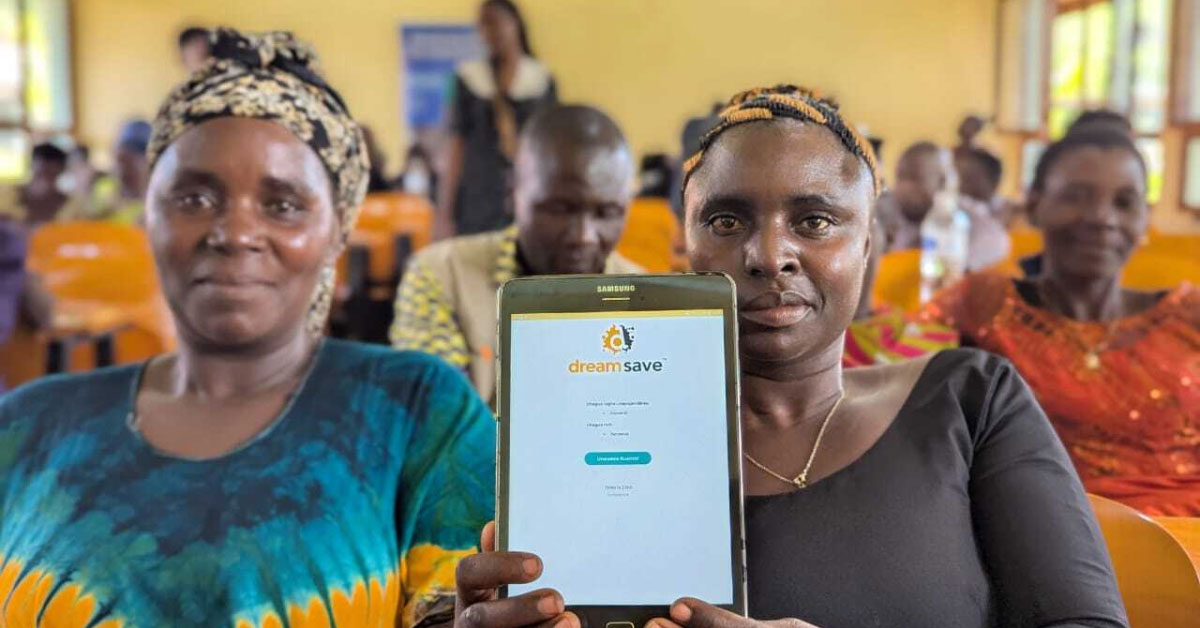
Platforms such as DreamSave were built around this principle. DreamSave digitizes the processes groups already understand. Groups continue saving together, issuing loans collectively, managing social funds, and operating according to constitutions they establish themselves. The difference is that these activities are now recorded digitally, with automated calculations, standardized record-keeping, and secure transaction histories that reduce administrative burden while improving transparency.
Technology, in this context, does not replace community governance. It supports it. It also strengthens something that many successful savings groups already recognize as essential: institutional memory.
Paper records are vulnerable to damage, loss, or human error. Leadership transitions can result in inconsistent record-keeping, while growing groups often face increasing administrative complexity. Digital systems preserve years of financial history, ensuring that institutional knowledge is retained even as membership changes and groups expand.
This matters more as groups mature and their transaction histories grow. The same review that documents these gains also flags where the evidence is thinnest: how groups can transition into broader financial ecosystems without losing the characteristics that make them successful.
That transition should not be mistaken for formalization. Digitization is not about transforming community finance into conventional banking. Nor is it about replacing weekly meetings with mobile applications. The social fabric of savings groups (the accountability, collective decision-making, mutual support, and peer trust) is precisely what makes them resilient. Technology cannot replicate those relationships.
Instead, technology documents them. It captures years of financial behaviour in a form that external institutions can understand. In doing so, it creates something that millions of financially responsible people have never had before:
A financial identity built on evidence. Because once years of savings, lending, and repayment are no longer hidden inside notebooks, they become a bridge to formal financial services.
From Digital Footprints to Financial Linkages: Making Financial Behaviour Count
For decades, financial inclusion has largely been approached as a question of access. How do we open more bank accounts? How do we issue more loans? How do we bring more people into the formal financial system?
These are important questions. But they assume that people outside the formal system have no meaningful financial lives until a financial institution reaches them. Savings groups tell a different story: one of financial activity that already exists but goes unseen.
Across much of the world, lenders rely on collateral, formal employment records, bank statements, or traditional credit scores to assess risk. Yet these requirements often exclude the very people who have demonstrated consistent financial discipline through savings groups for years.
A woman may have contributed to her savings group every week for five years. She may have borrowed multiple times. She may have repaid every loan in full. She may even serve as the group’s treasurer, managing thousands of transactions on behalf of dozens of members. Yet when she approaches a formal financial institution, she is often treated as someone with “no financial history.” Because no one can see it.
Digitization changes that equation. It creates opportunities that extend far beyond access to credit. A verified financial history can support access to microinsurance that helps families manage health emergencies or climate-related shocks. It can strengthen eligibility for agricultural finance that enables farmers to invest in improved seeds, irrigation, or equipment before planting seasons. It can support working capital for small businesses that have outgrown internal group lending while allowing entrepreneurs to continue participating in the community structures that helped them grow.
The savings group does not disappear. Its role evolves. Instead of being viewed as an alternative to formal finance, it becomes the foundation upon which broader financial relationships are built. Meaningful financial linkages work by connecting complementary systems, not extracting people from ones that already serve them well. Research points in this direction.
The same 2025 IPA synthesis cited earlier bears this out: across multiple countries, women in savings groups grew less dependent on high-cost informal lenders and increasingly accessed credit through structured, lower-cost channels. The review also identifies stronger linkages between savings groups and formal institutions as one of the most important opportunities ahead, and that opportunity reaches beyond banks and lenders. Governments can design policies around more reliable community-level financial data. Development organizations can monitor programmes without increasing reporting burdens on communities. Financial service providers can build products based on observed behaviour rather than assumptions about low-income households. Perhaps most importantly, communities themselves gain greater visibility into their own financial progress, strengthening transparency and accountability within their groups.
Seen through this lens, digitization is not merely a technological upgrade. It is an infrastructure for recognition: recognition that women saving every week are not charity recipients or passive beneficiaries, but investors, borrowers, lenders, entrepreneurs, and financial decision-makers contributing to local and national economies every day.
For too long, conversations about financial inclusion have focused on helping people “graduate” from informal finance into formal finance, as though one must replace the other. But in many underserved communities, the informal economy is not a temporary stage on the journey to development. It is the economy.
Savings groups continue to thrive because they are built around social trust, local accountability, and flexibility: qualities that formal financial institutions often struggle to replicate. Attempting to replace these systems risks weakening the very networks that make them effective. The future therefore lies not in substitution, but in interoperability.
Financial systems should be designed to meet people where they are, building on behaviours they already trust rather than expecting them to abandon those behaviours altogether. DreamSave makes this possible by creating a common language between community finance and formal finance.
One preserves trust. The other expands opportunity. Together, they create pathways that neither system could achieve alone.