

Savings groups existed long before banks began talking about inclusion. From rotating labor associations and Yoruba esusu to modern Village Savings and Loan Associations, their history reveals something important: people have always found ways to finance one another. Digitization is simply the latest chapter in that story.
In 1963, German economist and microfinance scholar Hans Dieter Seibel traveled to Nigeria to study industrial labor and cultural change. During interviews with factory workers, he encountered something that would shape much of his later work in finance.
Many of the workers were saving through a saving club known as esusu. They were not simply putting money aside for emergencies. They were saving with ambition. Many hoped that the money accumulated through their esusu would eventually help them establish their own small enterprises. Hair salons. Workshops. Restaurants. Trading businesses.
The encounter challenged a familiar assumption about finance: that meaningful financial activity begins when people enter a bank. But it does not.
For millions of people, financial activity began long before a bank account, a credit score or a formal lending institution entered the picture. They saved with one another, lent to one another, pooled resources, and developed rules for contribution and repayment. They created systems of accountability. And they used collective resources to finance their livelihoods.
Savings groups, in other words, are not a modern invention designed to solve financial exclusion. They are among the oldest forms of inclusive finance.
Today, they are often discussed through the language of development, financial inclusion and women’s economic empowerment. There are Village Savings and Loan Associations, Self-Help Groups, Savings and Internal Lending Communities and dozens of other variations implemented by organizations across the world.
But long before, communities had already developed their own systems. The story of savings groups is therefore not simply a story about finance. It is a story about how communities have repeatedly found ways to organize capital when conventional financial institutions were absent, inaccessible or simply not designed for them.
And it is a story that continues today. The difference is that, for the first time, technology may allow the financial activity that has existed for generations to become visible to the wider financial system.
Before there were savings groups, there was collective action
It is difficult to identify a single moment when savings groups began. There is no universally agreed date or a single founder. That is partly because the underlying principle is remarkably simple. When individuals cannot easily accumulate enough resources on their own, they can do so collectively.
Members contribute regularly to a common pool. The resources are then allocated according to rules agreed by the group. This principle has appeared in remarkably different forms across societies.
Hans Dieter Seibel’s historical account of savings traces one possible lineage through West Africa. During research in Liberia between 1967 and 1968, Seibel surveyed indigenous cooperatives among all 17 ethnic groups in the country. What he found was a wider ecosystem of collective organization.
There were savings and credit groups. There were rotating associations. And there were rotating working groups.
These working groups may offer an important clue to understanding the evolution of collective finance. Before money became the primary resource being pooled and allocated, communities could organize another scarce resource: labor.
Members worked collectively on one person’s farm or productive activity and then rotated to the next member. As one farmer in neighboring Côte d’Ivoire reportedly put it: “le travail, c’est notre argent”. Work is our money.
The principle is strikingly familiar. Everyone contributes. One member benefits. Then the group moves to the next. The same logic would eventually become recognizable in rotating financial arrangements.
The resource changed from labor to money. But collective contribution and rotation remained. Seibel described rotating working groups as a possible historical predecessor to rotating savings groups. That history matters because it challenges the idea that informal finance emerged as a substitute for formal banking.
In many places, these systems existed before people were even aware of modern banking. They were not copying banks. They were solving a problem independently.
Esusu and the long history of saving together
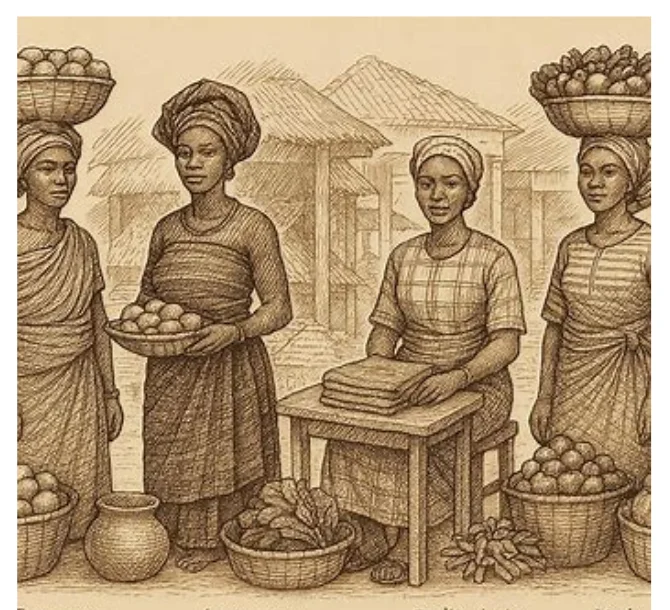
Nigeria provides one of the most widely documented examples of this history. Esusu was dated back to at least the 16th century, with Yoruba people carrying the practice across the Atlantic during the transatlantic slave trade. Variations subsequently appeared throughout the Caribbean and later within immigrant communities in North American cities. From Nigeria, savings clubs and ajó, a form of savings collection involving regular deposits and later payback, also spread across West and Central Africa and beyond.
Virtually every ethno-linguistic group in Nigeria has its own name for the practice. The Hausa call it adashi. Most adults belong to one or several. These systems also drew early outside attention. In 1934, C.F. Strickland, a former British colonial cooperative registrar, studied esusu in western Nigeria as a possible foundation for formal cooperative societies.
The exact historical origins of practices such as esusu should be treated carefully. Informal financial systems are often older than their written documentation, and different scholars identify different periods in their development. But what is difficult to dispute is their longevity.
For generations, people have contributed money regularly to collective arrangements that allow members to access larger sums than they could easily accumulate alone. In Nigeria, there is esusu and ajó.
Across Francophone Africa, similar arrangements are often known as tontines. It comes from Lorenzo de Tonti, a 17th-century Neapolitan banker who pitched a different scheme entirely, a survivorship-based annuity, to the French court in 1653. Centuries later, through colonial-era French, the name attached itself to West and Central African rotating savings practices. Those practices had nothing to do with Tonti’s original idea.
In other parts of the world, rotating savings arrangements have their own names, structures and social rules. But the fundamental idea remains recognizable. What is perhaps most remarkable is that this idea did not remain confined to one part of the world.
Historical evidence shows similar financial arrangements emerging across continents.
The ROSCA did not have one birthplace
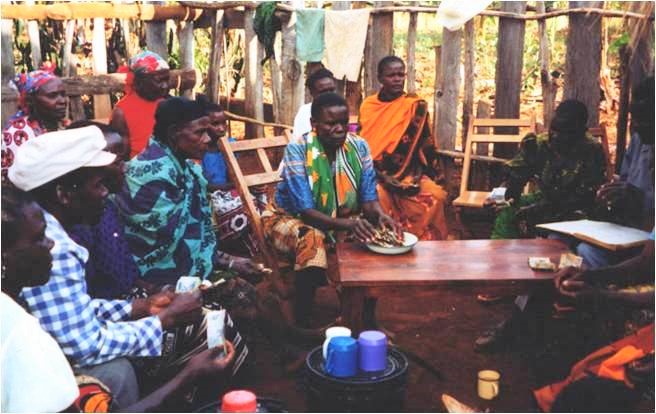
Today, one of the most widely used terms for this type of arrangement is ROSCA, or Rotating Savings and Credit Association.
A ROSCA generally works through regular contributions from members. At each meeting or contribution period, one member receives the pooled amount. The process continues until every member has received their turn.
It is an elegant system. Someone who receives the pool early effectively gains access to capital before they could have saved the entire amount independently. Someone who receives it later benefits from a structured mechanism for accumulating savings.
But where did the ROSCA originate? The most accurate answer is that we do not know of a single origin. And perhaps there was never one.
A recent historical study of ROSCAs in China provides an important example. Research into communal finance in Shanxi found that Chinese ROSCAs, known as hehui, have a history extending far beyond modern financial inclusion programmes. Some historical accounts trace them to the Sui dynasty. It became widespread practice by the Tang dynasty, between 618 and 907 CE, and the Song dynasty, between 960 and 1279 CE. By later periods, they were widely used to mobilize savings and provide credit, including for commercial activity.
The ROSCA is therefore better understood as a financial idea that repeatedly emerged wherever communities needed a practical way to mobilize resources collectively.
This is why savings groups can be found in such diverse settings. They are adaptable. Their names can change. Their rules can change. But the underlying principle remains useful.
People can often do collectively what they cannot do individually.
From rotating savings to accumulating capital
Not every community has regular incomes that make a rotating system practical. This distinction became particularly visible in Seibel’s research in Liberia.
In towns, where people were more likely to earn regular incomes, rotating savings groups were common. Members could contribute predictable amounts at regular intervals and receive the pooled sum according to the group’s agreed order.
Village economies often looked different. In communities where incomes were irregular, seasonal or dependent on agriculture, a rotating model could be less suitable. Instead, people formed Accumulating Savings and Credit Associations, commonly referred to as ASCRAs. Unlike a traditional ROSCA, money did not simply rotate from one member to another and disappear from the group’s pool.
Members made regular contributions that accumulated. The group could then lend from the collective fund. Borrowers repaid their loans, often with interest. That interest remained within the group and contributed to the collective resources available to members.
This was an important evolution. A ROSCA allowed members to take turns accessing a lump sum. An ASCRA created something closer to an internally managed financial institution. The group’s resources could grow. Loans could be issued. Repayments could replenish the fund. Interest could generate returns for members.
Seibel’s research in Liberia showed the importance of these accumulating associations, particularly in rural communities. This distinction would eventually become particularly significant for the modern savings group movement.
Because decades later, an international organization would build on this indigenous experience and help develop a methodology that could be replicated at scale.
1991: a new chapter in an old story
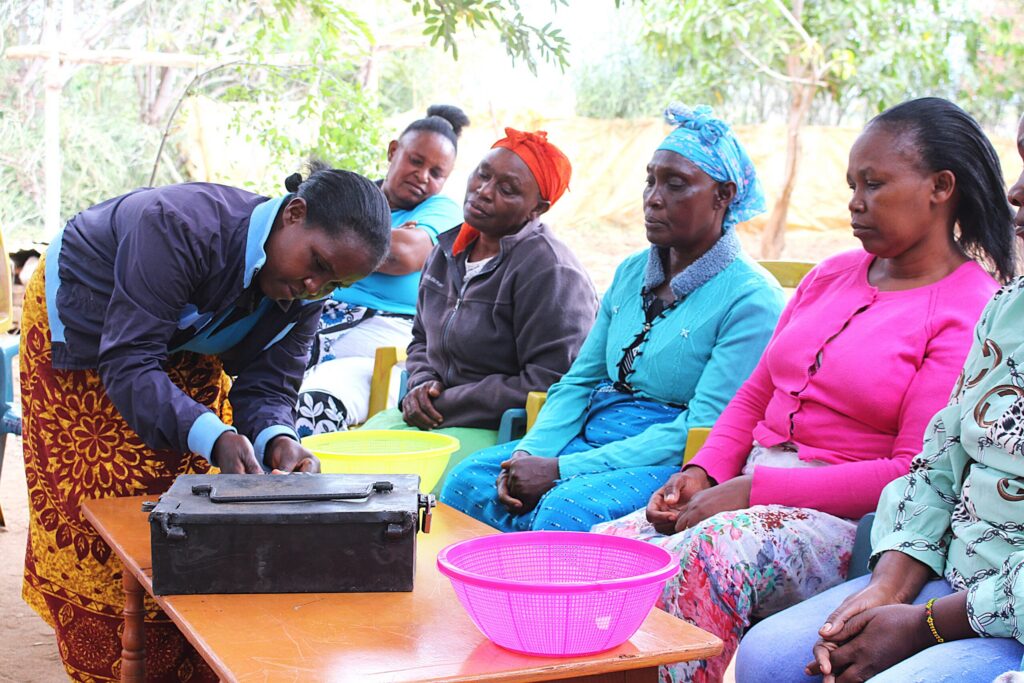
The Village Savings and Loan Association (VSLA), is often discussed as though it represents the beginning of savings groups. But the VSLA represents something different.
It represents a moment when a much older idea was systematized into a methodology that could be taught, replicated and scaled across countries.
In 1991, CARE sent a programme manager named Moira Eknes to a village in Niger to run a tree planting initiative. It was struggling. The women in the village could not own land, so they had little reason to invest in it. What they needed was capital, not trees. Eknes asked what they were already doing to get by. They described a method they already practiced. A small group. A few cents contributed each week. The pooled amount collected by a different member each round. A rotating savings group, in other words, by another name. Women there called it a “money merry-go-round.”
Eknes’s contribution was one small, familiar shift. Instead of letting the pool rotate and empty out, why not let it grow? Members could keep contributing, borrow from the accumulated fund when they needed to, and repay with interest, so the fund got bigger with each cycle instead of resetting to zero. A rotating structure had just become an accumulating one. It was the same shift from ROSCA to ASCRA that Seibel had surveyed in Liberia more than twenty years earlier, and arrived at again from scratch.
This was the birth of the VSLA and a transformational moment. Because the transformation was methodological.
The VSLA model introduced a structured approach to practices that communities already understood.
Groups could establish clear membership structures. Members could contribute savings regularly. Loans could be issued from the accumulated fund. Interest could be charged and eventually shared among members. Social funds could help members respond to emergencies. Groups could establish leadership structures and collectively agreed rules. Records could be maintained. And, importantly, the methodology could be taught to new groups.
This made replication easier. Other organizations could build on a foundational methodology while adapting it to local contexts.
Over time, this produced an ecosystem of related approaches. There were VSLAs. There were Self-Help Groups (SHGs). There were Savings and Internal Lending Communities (SILCs). And there were countless indigenous names and practices that continued to exist alongside these development methodologies.
Standardization created scale. But records created a new challenge.
As savings groups expanded, another challenge became increasingly apparent. Scale requires structure. And structure produces records.
A group needs to know how much its members have saved. It needs to know what happens when a member leaves. It needs rules for leadership, meetings and conflict. For many groups, these responsibilities have traditionally been managed through notebooks, passbooks, ledgers or other forms of manual record-keeping.
And for decades, this worked. It still works. But as the broader financial world changed, the limitations of paper records became more significant.
The modern conversation around financial inclusion expanded beyond the simple question of whether someone had a bank account. Financial institutions began looking at new ways to serve people outside traditional banking systems.
Mobile money expanded. Digital payments grew. Alternative approaches to assessing financial behavior began emerging.
Financial service providers increasingly recognized that a person could be economically active without having a formal salary, conventional collateral or a traditional credit history.
A farmer could be financially active. A trader could be financially active. A small business owner could be financially active. A member of a savings group could be financially active. But there was still a problem.
The formal financial system could only work with information it could see. And much of the financial history of savings group members remained locked inside paper records.
Imagine someone who has saved every week for five years. She has borrowed from her group. She has repaid her loans. She has used capital to support a business. She may have managed money for her group as a treasurer. She may have participated in multiple savings cycles. From her community’s perspective, she has a financial history.
But from a bank’s perspective, she may have none. Because her financial activity is invisible.
That is the problem digitization begins to address.
Digitization is the latest chapter, not a replacement
There is a temptation to tell the history of financial technology as a story of progress.
First came informal systems. Then came formal systems. Then came digital systems. But that story is too simple.
It assumes that each new system replaces the one that came before it. Savings groups show us why that is not necessarily true.
The social structures that made collective finance work hundreds of years ago still matter today and technology cannot replace those things. Nor should it try. The role of digitization is different. It can help make the existing system more efficient, transparent and visible.
A digital savings group platform can record contributions. It can track loans and repayments. It can automate calculations. It can manage social funds. It can preserve financial records over time. It can reduce the administrative burden associated with manual bookkeeping. It can create a more reliable institutional memory for the group. And, perhaps most significantly, it can begin to create a digital record of financial behavior.
This is where the historical story of savings groups meets the future of financial inclusion.
For centuries, people have saved, borrowed, and repaid. But not every saving history has been visible and not every repayment has contributed to a formal credit history.
People have built businesses with internally generated capital. But the economic activity created through those businesses has often remained disconnected from the institutions capable of providing larger financial products.
Digitization creates an opportunity to change that.
From a paper ledger to a financial footprint
This is where solutions such as DreamSave enter the story. It creates a digital footprint that opens possibilities that a paper ledger cannot easily create on its own.
With appropriate systems, safeguards and partnerships, documented financial behavior can help financial service providers better understand people who have traditionally existed outside conventional credit assessment systems.
This could create pathways to financial products such as credit, insurance and other services. But the goal should not be to make savings groups disappear once their members gain access to formal finance. That would repeat an old mistake in the financial inclusion conversation. The goal is linkage.
Community finance and formal finance can serve different purposes.
Savings groups can continue providing something that formal institutions often cannot: local trust, flexibility, collective accountability and immediate access to internally generated capital.
Financial institutions can provide services that a group’s internal capital may eventually be unable to support, including larger loans, insurance and more specialized financial products.
The future is therefore not necessarily a transition from informal to formal. But a connection between the two.
An old idea with a new kind of visibility
The history of savings groups should change the way we think about financial inclusion.
Too often, financial inclusion begins with the assumption that people outside formal institutions are financially excluded because they are not financially active.
But history tells us many people have always been financially active. The Yoruba factory workers Seibel encountered in Nigeria in 1963 were saving. The members of gbe associations documented in Dahomey were saving. The indigenous cooperatives surveyed across Liberia were saving and lending. Chinese communities participating in historical ROSCAs were mobilizing capital. Farmers and craftsmen in nineteenth-century Germany were organizing self-help associations.
Savings groups have survived because they are not dependent on one particular technology, organization or historical period. They adapt and that may be their greatest strength.
The VSLA methodology was one adaptation. It took principles that had existed in communities for generations and organized them into a model that could be replicated at scale.
Digitization is another. It helps the model communicate with a financial system that increasingly operates through data. That is perhaps the most important lesson from the history of savings groups.
The next chapter
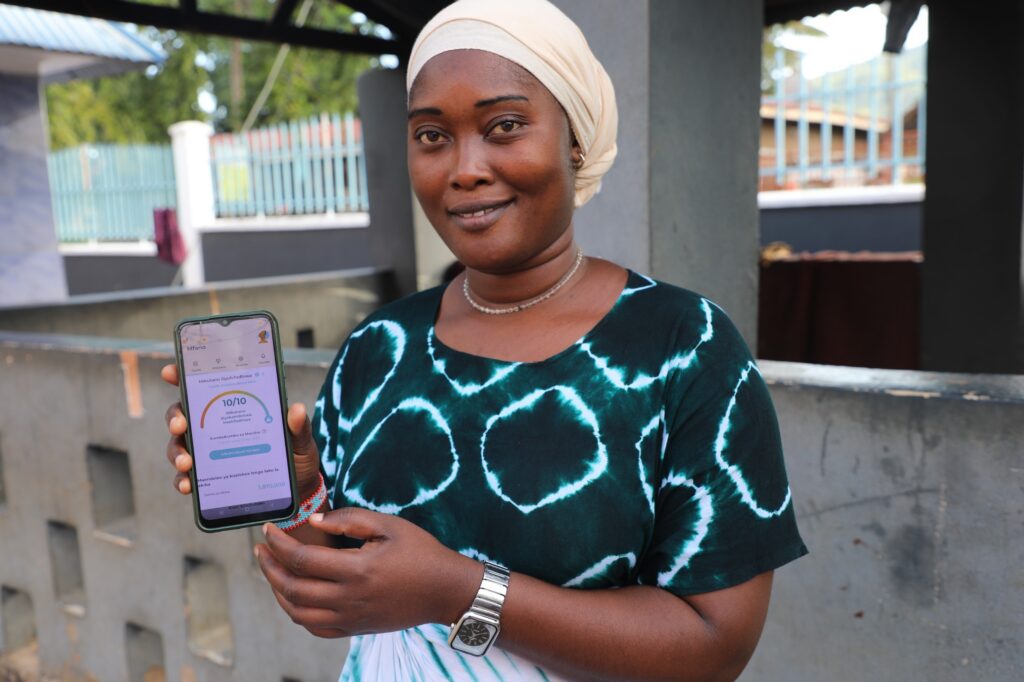
Savings groups have traveled a long way. From rotating labor associations to rotating savings. From indigenous cooperatives to accumulating savings and credit associations. From esusu and ajó to ROSCAs. From community-led practices to VSLAs, SHGs and SILCs. And now, from paper ledgers to digital records.
But perhaps the most remarkable thing about this history is not how much savings groups have changed. It is how much has remained the same.
At their core, savings groups still begin with that simple idea: People can build financial security together.
That idea has survived centuries. It has crossed continents. It has traveled with migrants. It has adapted to cities and villages, agricultural economies and trading communities. It has been formalized into methodologies and translated into dozens of languages.
Now, it is entering the digital age.
The next chapter is to understand what becomes possible when a financial system that has existed for generations is given new tools for transparency, efficiency and visibility.
Savings groups do not need technology to prove that they work. History has already done that.
But technology may help ensure that the millions of people who have been saving, borrowing, repaying and building livelihoods together for generations are finally visible to the systems that have, for too long, failed to see them.