

Saving is not a new idea. Long before digital wallets, mobile banking and financial technology, people found ways to put money aside for the future. They saved in boxes, contributed to community savings groups, kept money with trusted individuals and built informal systems to help them prepare for expenses, manage uncertainty and pursue their ambitions.
Yet, while the practice of saving has endured across generations, the knowledge and confidence to make informed financial decisions have not always been as accessible.
That is an important distinction to consider on World Savings Day.
Established in 1924 at the first International Thrift Congress in Milan, World Savings Day was created to promote the habit of saving and encourage people to use savings institutions to build greater financial security. A century later, the conversation has evolved considerably. The ways people save have changed, the tools available to them have expanded, and the financial decisions they face have become increasingly complex. But the underlying purpose remains relevant: helping people build a more secure financial future.
The 2026 theme, “AI advises. Human decides,” brings this conversation into the present. It recognizes the growing influence of technology and artificial intelligence in how people access information, manage money and make financial decisions. But it also reinforces an important principle: technology can inform our choices, but the agency to make those choices must remain with us.
For financial inclusion, that principle matters.
The money conversations many of us never had
In many developing economies, financial education is not something everyone grows up with. Conversations about money, savings, borrowing and investment are often absent from both formal education and the home.
Money can also be a difficult subject to discuss openly. People may feel uncomfortable talking about what they earn, how much they spend or the financial challenges they face. Asking someone to repay money can strain a relationship. Admitting that you are struggling financially can carry feelings of shame or inadequacy. For women in particular, conversations about money and financial independence can be shaped by social expectations about their roles, responsibilities and place in the household.
When money is treated as something private, uncomfortable or even shameful, opportunities to learn about it become limited.
Children may grow up understanding that money is important without learning how to manage it. They may know that they should save without understanding how savings work, where to keep their money, how to set financial goals or how to make informed decisions about borrowing and investing.
One of the few saving habits that has traveled across generations is the personal savings box.
Many people will remember receiving a small savings box or piggy bank as children. Parents and relatives encouraged them to put away some of the money they received from family and friends, or a portion of their lunch allowance. The amounts were often small, but the lesson was simple: money set aside today could become something more tomorrow.
At the end of the year, the box would be opened, the money counted and the savings put towards something the child wanted or needed. It could be a new outfit, a toy or something special.
It was an early introduction to delayed gratification, consistency and the satisfaction of seeing small contributions accumulate.
But there is a difference between learning to put money aside and understanding how to make financial decisions with that money. The savings box teaches the habit. It does not necessarily teach the wider financial knowledge needed to manage savings, understand interest, evaluate financial products, borrow responsibly or use capital to grow a business. That knowledge has to be developed.
Saving is only the beginning
The importance of financial education becomes clearer when we look at how people actually save.
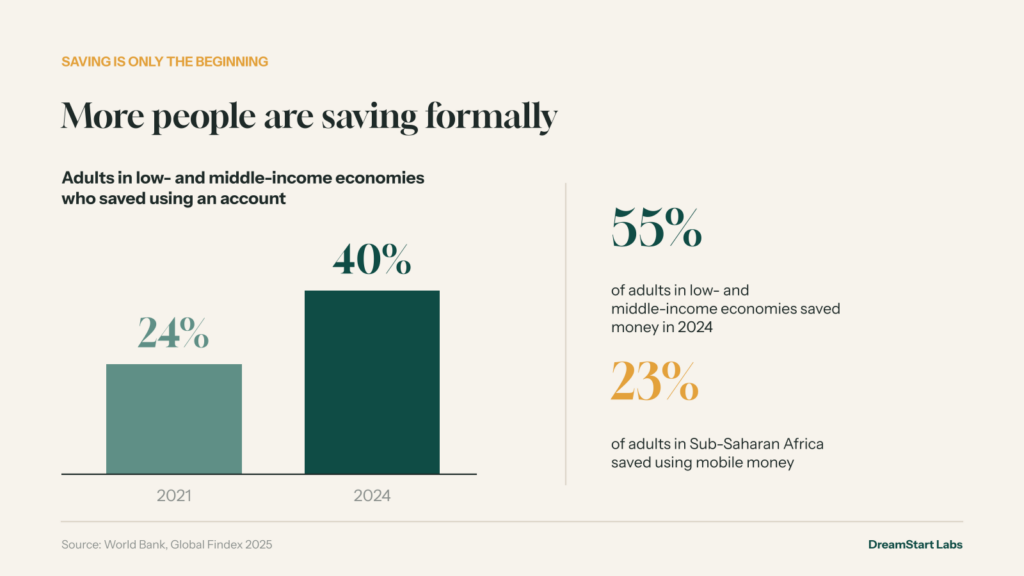
The World Bank’s Global Findex 2025 report found that 55% of adults in low- and middle-income economies saved money in 2024. Forty percent saved through a formal financial account, up from 24% in 2021. In Sub-Saharan Africa, 23% of adults used a mobile money account to save. These figures show that saving remains widespread and that digital financial services are creating new ways for people to put money aside.
But saving is not simply about accumulating money. It is also about understanding what that money can make possible.
For an individual, savings may provide a buffer against an unexpected expense, help cover school fees or rent, or create the capital needed to start a business. For a small business owner, savings can help manage fluctuations in income, purchase equipment or finance expansion. In a savings group, collective contributions can provide members with access to loans, help them meet household needs and support productive investments.
Borrowing, too, needs to be understood in context.
In some communities, taking a loan is associated with financial difficulty or an inability to manage money. As a result, people may hesitate to borrow even when access to appropriate financing could help them expand a business or invest in an opportunity.
Responsible borrowing is not inherently a sign of financial distress. When the terms are fair, the repayment obligations are manageable and the purpose is well considered, credit can be a tool for economic activity.
The challenge is helping people understand the difference between borrowing that creates opportunity and borrowing that exposes them to unnecessary risk.
This is why financial literacy cannot be reduced to telling people to save more. It should help them understand the relationship between saving, borrowing, investing, risk and their longer-term financial goals. It should equip them to ask questions, compare options and make decisions based on their circumstances.
And this education cannot happen through a single training session or awareness campaign. It is an ongoing process that develops as people’s financial needs and responsibilities change.
Technology has made financial knowledge more accessible, but access is not the same as understanding
The digital age has changed how people access financial information.
Today, people can find resources on budgeting, saving, investing, managing debt and starting a business through online platforms, digital courses and financial applications. Savings platforms can help people set goals, monitor progress and understand how regular contributions accumulate over time. Digital tools can also make financial information easier to access and use.
Artificial intelligence is extending these possibilities further. It can help people interpret financial information, identify spending patterns, explore different saving strategies and understand financial concepts that may otherwise feel difficult to navigate.
But having access to information does not automatically mean having the knowledge to use it well.
People still need to assess the reliability of what they are reading, understand the risks associated with financial products and recognize when advice does not reflect their personal circumstances. They also need to know how their financial information is being collected, stored and used.
This is particularly important as financial services become increasingly digital. Innovation must be accompanied by financial education, data security, transparency and consumer protection. Without these safeguards, technology can create new forms of vulnerability even as it expands access.
The 2026 World Savings Day theme captures this balance. AI may offer recommendations, but people need the knowledge and confidence to evaluate those recommendations and make their own decisions. The objective should not be to replace human judgment with technology, but to make better information and tools available to support it.
Taking financial education closer to the people who need it
While digital platforms have made financial information more accessible, they are not the only route to financial education.
For many underserved communities, particularly those with limited access to digital infrastructure or formal financial services, development organizations, community institutions and financial inclusion initiatives play an important role.
They bring financial education directly into communities, helping people understand savings, loans, financial management and the services available to them. They also work with people to build the confidence and capabilities needed to participate in financial systems.
This is especially important for women, who may face barriers that go beyond the availability of financial products. Social expectations, limited control over household resources, unequal access to assets and restricted opportunities to make financial decisions can all affect their ability to build financial independence.
In these contexts, financial inclusion requires more than introducing a new financial product. It requires creating the conditions in which people can understand, access and use financial services with confidence.
Savings groups offer one example of how this can happen. Through collective saving and lending, members learn to manage money, make financial decisions, assess borrowing needs and take responsibility for shared resources. Development partners often support these groups with financial education and training, helping members strengthen their financial management practices.
Technology can complement this work. For example, DreamStart Labs’ DreamSave provides savings groups with digital tools to record savings, loans, repayments and other group transactions. By making financial records easier to maintain and understand, it supports the management of the group’s existing financial activities.
But the value of introducing a tool like DreamSave is not simply that a group moves from paper records to digital records. It is also about helping members develop the confidence to use technology, understand their financial information and participate more actively in managing their collective resources.
The technology supports the process. The knowledge, decisions and ambition belong to the people using it.
The future of saving still belongs to people
The 2024 World Savings Day campaign explored a century of saving, tracing the journey from the traditional piggy bank to the digital wallet. It was a reminder of how much the tools and institutions around saving have changed.
The 2026 theme takes that conversation further by considering how artificial intelligence is reshaping financial decisions.
Across both moments, one thing remains constant: people have always found ways to save. They have done so through personal savings boxes, community savings groups, banks and, increasingly, digital platforms.
What remains important is ensuring that people have the financial knowledge, confidence, access and protection to make those savings meaningful.
Technology can make saving easier. It can make financial information more accessible, help people track progress and create new pathways into formal financial services. But it cannot replace the need for financial education, nor should it take away people’s ability to decide what is right for their lives.
A savings habit is a valuable starting point. Financial agency is what allows that habit to become a foundation for greater security, opportunity and independence.
This World Savings Day, we celebrate everyone who continues to save, plan and make decisions towards a more secure future. We also recognize the families, community institutions, development organizations and financial service providers working to make financial knowledge and opportunities more accessible.
AI may advise. Technology may support. But the future we save for, and the decisions we make along the way, should remain ours.
Happy World Savings Day.